Today is World Environment Day, and this year the United Nations Environment Programme (UNEP) is calling on governments, cities, businesses and people everywhere to “read the signals and send one back.”
“Start a conversation. Fund a solution. Shift a policy. Share a story. Make your moves in ways that move others,” UNEP says. “Every action is a signal.”
The International Fencing Federation (FIE) is doing our part by bringing into focus some of the concrete measures we are implementing to ensure a greener future for the planet.
In addition to projects such as Donate Your Fencing Gear, which minimises waste by giving sed gear a second life through use by other fencers on their journeys in the sport, the FIE is raising awareness of environmental issues within the fencing community through knowledge sharing, education and initiatives such as the Fencing for the Planet roundtable.
In collaboration with the Brazilian Fencing Federation (CBE), the FIE organised its second Fencing For the Planet roundtable this April on the sidelines of the Rio Junior & Cadet Fencing World Championships.
Building on the success of the inaugural edition last year in Tbilisi, Georgia, the Rio roundtable brought together athletes, experts and key stakeholders to explore the various environmental initiatives being implemented in fencing and their impact around the world.
The event was opened by FIE Interim President Abdelmoneim ElHusseiny, who welcomed participants as “partners in a global mission to safeguard the future of the planet.”
‘Fencing is ready to be in this moment’
In her opening address, FIE Secretary General Gulnora Saidova observed that sustainability efforts are moving from ambition to action. “Fencing is ready to be in this moment,” Saidova said. “Through recycling equipment, reusing materials, repair programmes and donating gear, we are already demonstrating that the circular economy isn’t just a concept, it’s a reality.”
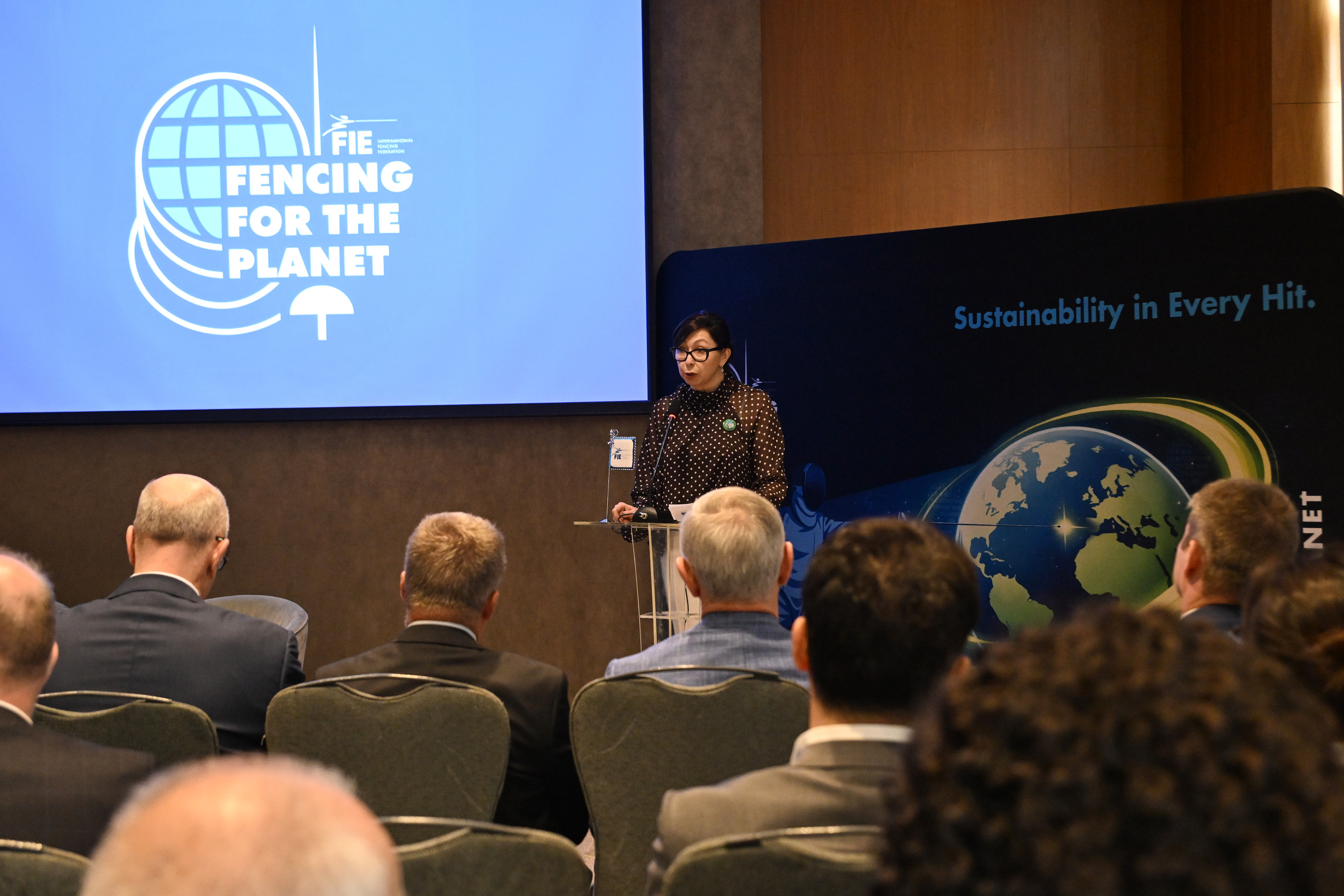
As part of the FIE’s 2025-2028 Strategic Plan, Fencing for the Planet is a rallying call for the international fencing family to do more – collectively – for the environment. By wielding both weapons and sustainability, the FIE and its members aim to protect not only the legacy of the sport but also the health of the planet for generations to come.
Head of the First Fencing and Environment Working Group and FIE Ambassador for International Relations in connection with the preparations for the 2028 Olympic Games in Los Angeles, USA Ana Irene Delgado spoke with pride about how the programme has grown from a shared vision into a meaningful global movement whose work is closely aligned with the United Nations Sustainable Development Goals.
Following remarks from FIE Executive Committee member, CBE President, and current Head of the FIE Fencing and Environment Working Group Arno Schneider, video messages were played from IOC Sustainability Manager Fabrizio d’Angelo and Brazilian Olympic Committee Manager of Culture and Olympic Values Carolina Araujo.
The first session of the roundtable focused on practical and technical solutions for reuse, repair and recycling within fencing. Rio 2016 Olympic Champion and Deputy Vice-President of the Italian Fencing Federation Daniele Garozzo spoke about the Ecoblade project for the recycling of maraging fencing blades, while President of the FIE Women and Fencing Council Melissa Alvarenga shared how damaged or older fencing equipment and material can be repaired, shared and repurposed, thus having a positive environmental and economic impact while promoting solidarity within the fencing community.
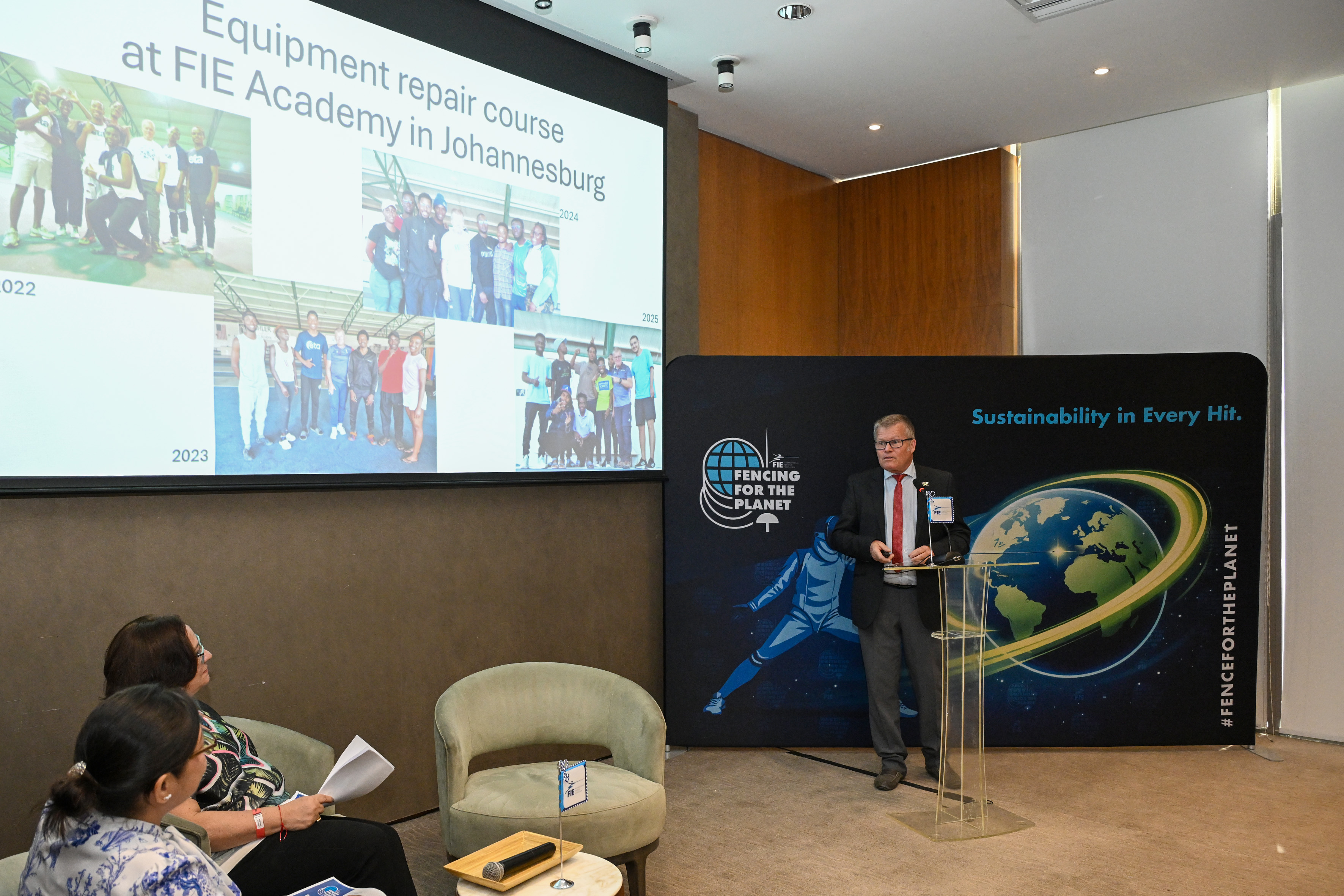
Participants also enjoyed a presentation by FIE expert and Armourer of the French Fencing Federation Gilles Martinage. Martinage spoke about how students at the FIE Coaching Academy in Johannesburg (all of whom are fully sponsored by the FIE) are benefitting from an equipment-repair course offered by the Academy during the September break.
Olympic Legacy
Rosele Sanchotene, Marketing and Communications Director at the CBE, revealed how the legacy of the Rio Olympic Games continues to this day through the use of the 2016 Olympic Park facilities, including for the 2026 Junior & Cadet World Championships. Sanchotene heralded the facilities as a “model for stadium reuse.”
In the second session, the roundtable examined the impact fencing-equipment donations were having on the development of fencing and the recipients themselves. Donor motivation and the logistics of moving surplus gear from developed fencing nations to developing regions were among the topics of interest highlighted by three-time Olympian and Vango Director of Operations Michel Dessureault.
Seventeen‑year‑old Brazilian foilist Samara Silva spoke movingly about her experience as a beneficiary of the FIE’s Donate Your Fencing Gear programme, describing the donation as a “vote of confidence” to continue her career.
Participants also learned from Oficina Muda CEO Larissa Graven about the company’s initiatives to recycle clothing, thereby reducing the environmental impact of textile waste. Oficina Muda works with over 300 artisans, many of whom are women in vulnerable situations, empowering them to generate income to support their families. In this context, the Brazilian Fencing Federation (CBE) is also taking a step forward in its sustainability efforts by launching a pilot project with Oficina Muda to recycle fencing equipment.
Saving the planet; Saving the person
Additionally, a presentation by El Floral Academy Director Fatima Tobar showed how sustainability is both about “saving the planet” and about “saving the person” as it provides the very means necessary to participate in sport.
Both sessions concluded with a Q&A session that was open to those in the room as well as those following the livestream on the FIE’s Fencing Channel on YouTube.
A key feature of the Fencing for the Planet initiative, the roundtable demonstrated that responsible consumption can be achieved through technical innovation and social programmes. The roundtable concluded that environmental conservation and the sustainable development of fencing are inseparable: the sport cannot grow without protecting the resources on which it depends.
Indeed, since the start of the 2025-2026 season, the FIE has officially integrated IOC-aligned sustainability requirements into its competitions, transforming environmental responsibility into mandatory action and delivering concrete and measurable outcomes through partnerships, innovation and eco‑measures.
“Together we can ensure that our sport continues to flourish while contributing meaningfully to the preservation of our shared home,” said FIE Interim President ElHusseiny.
The full recording of the roundtable discussion is available here.