
Connecting generations
The History of Fencing

Ancient times
The first traces of fencing
Whether we consider fencing as an art of enjoyment or as a science of arms, a method of education or a sport, its wealth emerges from its study. Wealth of a thousand-year-old history, of a large technical skill and a laudatory record of achievements, wealth of champions and masters who force the respect, and above all wealth of values that fencing knew how to generate and that it still tries to inculcate today through its practice.
The history of this sport is very eloquent, it often relates that of humankind through that of the sword and, if we analyse the feature of the art of weapons, we immediately notice that it corresponds to the customs of the era in which it appears. The human being has always tried to invent weapons to defend himself against the nature and other human beings, and this since Caïn: he used his strength, resorted to his material, improved his dexterity and used his intelligence. The history of fencing gives a marvellous account of all that.
1190 BC
The Pharaohs invent the mask and the competition
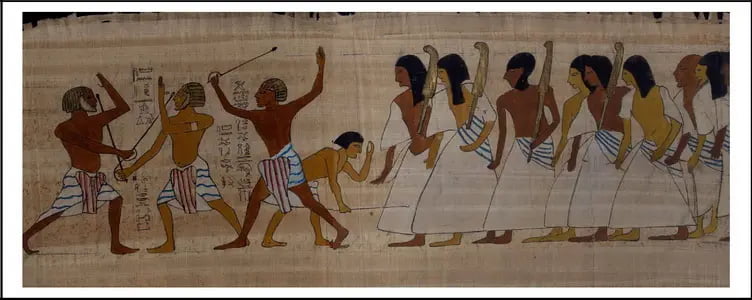
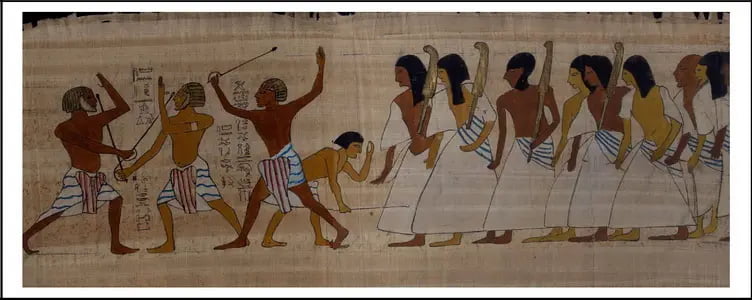
Four centuries before the Olympic Games of Antique Greece, a bas-relief in the temple of Medinet-About in High Egypt and built by Ramsès III in 1190 BC, depicts a sporting competition organised by the Pharaoh to celebrate his victory over the Libyans. The weapons - certainly sticks with bronze plates in the end - are buttoned. Hands are protected by a guard similar to that of sabre, and some of the fencers have the face protected by a mask, whose chin rolling pad, covering both ears, is attached to the wig. The non-sword arm is used for parrying blows and is protected by a kind of shield.
The translation of hieroglyphs teaches us that the opponents shouted at each other « On guard … and admire what my valiant hand is going to make! », and that spectators did not spare encouragements for their favourites: « Go ! O excellent fighter! ». The winner salutes with his weapon and hand the Pharaoh who is accompanied by his suite. The public is composed of Assyrians, Libyans and Egyptians; the jury and the organisers are recognizable thanks to their feather. A scribe notes on a papyrus the results of the competition.
776 BC
The Games of the Olympe
It is necessary to cross ages and transport ourselves in Greece to find in the hoplomachie (fight with weapons one to one) the tracks of a competition where prizes were proposed to the winners, « grown men or children ». Many of us know that fencing was included in the programme of the first games of the new era, in 1896, but many ignore that it was certainly included in the first Olympic Games in 776 BC. Sensitive to the equal education of the body and the soul of their youth, the Greeks honoured all the games preparing to the profession of arms. Olympic combats in which athletes (word derived from the Greek « combat ») had to be Greek, free and beyond reproach.
If the first laurels awarded during these events are regrettably unknown to us, we can learn from the Dictionary of Greek and Roman Antiques,3 that in the IIIrd century, in Teos, in Greece, the «hoplomachès» (fencing master) was paid 300 drachmas: much more than the archery master or javelin master. This book evokes, in the 5th century, two masters with a great reputation (Euthydème and Dyonysodore) who taught the hoplomachie (fencing) in return for a great reward
648 BC
Thrusting fencing of the Romans
In 648 BC, the education of fencing, or armatura, was introduced into theRoman camps by the consul Rutilius, in order that « the courage joins the art, and the art the courage ». So, fencingstrengthened itself of the impetuosity of courage, while courage borrowed from fencing the science and the skill. Fencing was practised with two hands : one was parrying the thrusts with the help of a shield, the other one was hitting with the two -edged sword. The bad pupils of the instructor officers (lanistes, campiducteurs or rudiaires) were deprived of wheat and received strong ration of barley and were sentenced to lashes (Virgile, Enéide, book I). Their « doctores armorum » established rules to avoid thrusts or execute thrusts more skillfully. In particular, they recommended thrust with the point, which is more mortal than the thrust with the edge.
For the knight or the equerry, fencing was part of the good education which he had to receive before his consecration by « dubbing », « investiture ». The profession of arms was long and painful for the young noble, until the solemn day when, finally, the blessed sword, symbol of glory, justice and moral value, was handed to him together with the shield and the spear. Once the initiation over and the accolade given, we let the noble knight go towards single combat for the defence of the weak and the oppressed, but also towards tournaments which represented a source of profit : the knight received the horse and the armor of the opponent which he had defeated with courtesy or dulled weapons. The arrival of firearms and the invention of Gutenberg were determining for fencing, which saw its weapons become lighter and its techniques popularised. Before these inventions, this main occupation of the nobility and the elite of the society was especially an occult science and the secret strikes were as popular as the philosopher's stone or the long life elixir. From this knowledge depended more than life, justice and honour.
12 - 13TH CENTURY
Fencing for honour, justice and faith
In the XIIth and XIIIth centuries, we already meet in France « givers of lessons » and advice in fencing, whose function was to prepare to the judicial duel and, sometimes, against very high sum, replace on the spot the parties in presence.
There were the counsels of arms, who became the « bravi » of Lombardie and the swordplayer and maistres.
The judicial duels took place until the XVIth century. The truth and the right cause could only triumph in these « God judgements » in which sword ruled and divided the truth from the false ; the faith, for which the glory was only vanity, could only praise the value through the filter of a highly moral purpose.
Further some miscarriages of justice in which «God's hand» had less weight than the power of fencing, the ordeal (from the old English ordal and German urthel) was finally suppressed and replaced by a more human justice. The fact remains that the symbols of sword and justice crossed the centuries and are still today associated, imbuing fencing with a strong ethics.